
Thread Lift Types Explained: PDO Cog, Jamber and Silhouette Soft
Published · 6 views
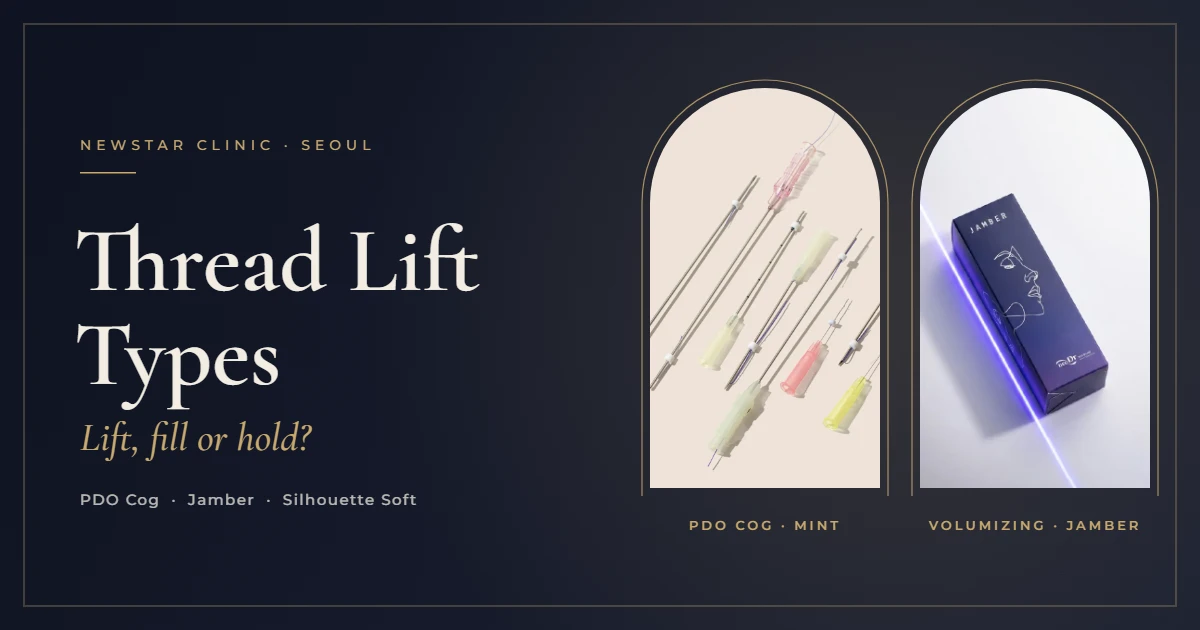
Not every thread lift does the same job. PDO cog threads such as Mint lift sagging tissue, Jamber is a spring-shaped thread that fills hollows, and Silhouette Soft uses cones to hold the mid-face higher. Results usually last around a year, and swelling settles within one to two weeks.
Medically reviewed by Dr. Kang Kun Woo, Chief Doctor, Newstar Clinic · Last reviewed: October 28, 2026
"I know threads can lift my jawline, but my real problem is the hollow in my cheeks. Can a thread lift fix that too?" We hear this question often. The answer depends on the thread. Some threads pull tissue up, some fill hollows, and some use small cones to hold tissue in place. They do different jobs.
Thread types at a glance
PDO cog threads (Mint, Dual Line): barbs hook and lift tissue · sagging jawline, cheeks and nasolabial folds
Jamber: a spring-shaped PDO volumizing thread · hollow front cheeks, deep nasolabial folds, Indian bands and marionette lines
Silhouette Soft: PLLA/PLGA thread with two-way cones · mid-face lift
Aptos: threads made of PLLA and caprolactone (PCL) · lift and skin quality
What does a thread lift actually do?
A thread lift places absorbable medical threads under the skin. They do three things: barbs or cones hook sagging tissue and hold it higher, the thread itself adds support where the face has hollowed, and as the thread slowly dissolves it helps new collagen form around it. Some threads are better at lifting, others at filling.
How do PDO cog threads (Mint, Dual Line) lift?
PDO (polydioxanone) is a suture material the body slowly absorbs. Cog threads have barbs along their surface that catch sagging tissue and anchor it higher. Mint is a PDO thread sold in the US as MINT, and it has received three FDA 510(k) clearances (source: MINT). Dual Line is also a PDO thread. It uses a V-shaped needle and 360-degree spiral barbs to grip tissue, and we mainly use it for a loose jawline and sagging around the nasolabial folds.
What is a Jamber thread, and why is it called a volumizing thread?
Jamber is a long PDO thread wound tightly into a spring shape. The coiled thread fills a hollow as soon as it goes in. Over the following weeks, collagen forms inside and around it and supports the tissue, much like a ligament. In clinical cases published in 2024, Jamber placed in the nasolabial folds and front cheeks kept its effect for about six months (source: Archives of Plastic Surgery). On its own, though, it adds less volume than filler, and it does not pull tissue up.
"Where a face needs volume, we use Jamber. Where it sags, we add Mint threads. That way we plan filling and lifting in the same treatment," says Dr. Kang Kun Woo, Chief Doctor at Newstar Clinic.
How are Silhouette Soft and Aptos different?
Silhouette Soft threads are made of PLLA and PLGA, with small cones running in two directions. The cones grip tissue and lift it. In the US, the same thread is called Silhouette InstaLift, and it was FDA cleared in 2015 for mid-face lifting. Aptos threads, from a company in Georgia, are made of PLLA blended with caprolactone (PCL). The Aptos Namika line adds a slow-release form of hyaluronic acid.
Which thread is right for my concern?
Sagging jawline or cheeks: PDO cog threads (Mint, Dual Line) or Silhouette Soft
Hollow front cheeks, deep nasolabial folds, Indian bands or marionette lines: Jamber
Sagging and hollowing together: Mint and Jamber combined
More volume needed: Jamber with filler or a collagen-stimulating treatment
Your doctor chooses the thread type and the number of threads after looking at the direction of sagging, fat distribution and skin thickness.
How long does a thread lift take, and does it hurt?
The treatment takes about 40 to 50 minutes. We apply numbing cream first, then local anesthetic before placing the threads.
How long do thread lift results last, and what are the side effects?
We usually explain that the lifting effect lasts around a year. It varies with the type of thread, the area treated, your skin and how quickly your skin ages.
"How long a thread takes to dissolve and how long the lift lasts are two different things," Dr. Kang explains.
Common reactions are swelling, a feeling of tightness and some temporary unevenness. Rarely, a thread can push out toward the inside of the mouth or nose, or a thread placed too close to the surface can be visible. In those cases, the thread can be removed.
Can I fly home after a thread lift?
Swelling and tightness usually settle gradually within one to two weeks. If you are flying home after treatment, we recommend leaving at least one to two weeks between your thread lift and your flight where possible. If your trip is shorter, tell us when you book, and your doctor can adjust the thread type and number.
Thread lift or a lifting device: which comes first?
Lifting devices tighten the skin with heat, while threads physically hold or fill tissue. If sagging is mild, a device is often enough. If sagging or hollowing is clear, threads are added. For how XERF, Ultherapy, Thermage and Sofwave compare, see our lifting device guide. If lost volume is the main issue, see Ozempic Face: What Causes It and How Fillers Can Restore Lost Volume.
How is the cost of a thread lift decided?
There is no single price for a "thread lift". It is priced by thread type and by the number of threads, so two plans with the same name can cost different amounts. Once your doctor has chosen the threads and the count, you see the full amount, including 10% VAT, before treatment begins.
Not sure whether your face is sagging, hollowing or both? Send front and side photos and your Seoul dates on WhatsApp.


