
Juvelook vs Rejuran: Which Korean Skin Booster Is Right for You?
Published · 3 views
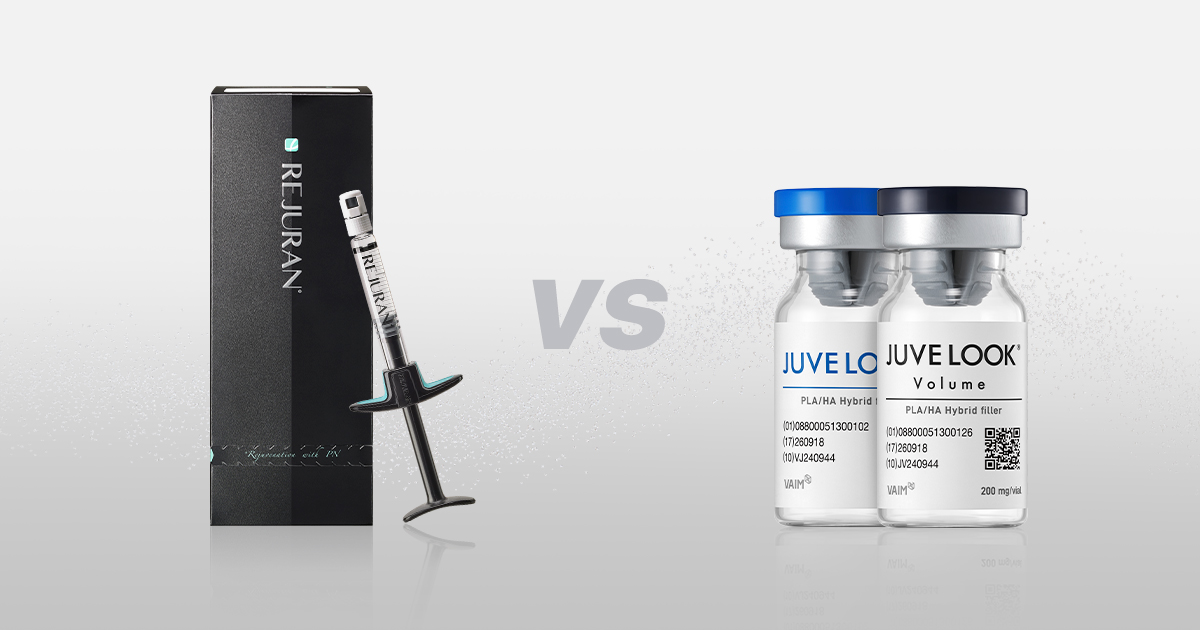
Juvelook and Rejuran are both Korean skin boosters, but they work differently. Rejuran (PN) helps repair thin, tired skin. Juvelook (PDLLA + HA) stimulates collagen for firmness, pores and acne scars. Many patients combine both.
Medically reviewed by Dr. Kang Kun Woo, Chief Doctor, Newstar Clinic · Last reviewed: October 20, 2026
Juvelook vs Rejuran at a glance
Main ingredient: Rejuran – polynucleotides (PN) from salmon DNA / Juvelook – PDLLA (poly-D,L-lactic acid) + hyaluronic acid (HA)
How it works: Rejuran – supports skin repair and skin quality / Juvelook – stimulates your own collagen over time
Best for: Rejuran – thin, dull, tired or sensitive skin, fine lines, under-eye skin (Rejuran Eye) / Juvelook – enlarged pores, acne scars, rough texture, early loss of firmness
Typical course: Rejuran – 3 to 4 sessions / Juvelook – 3 sessions about 6 weeks apart
FDA status: neither is FDA-approved in the US
What is Juvelook? Is it a filler?
Juvelook is a collagen-stimulating injectable made in Korea by VAIM and launched in 2019. It contains PDLLA (poly-D,L-lactic acid) in tiny porous spheres, carried in hyaluronic acid. The hyaluronic acid gives a light, immediate effect, and the PDLLA helps your skin build its own collagen over the following weeks. Medical journals describe it as a "biostimulatory" or "hybrid" filler. It is not a classic volume filler that shows results right away.
What is Rejuran?
Rejuran is a polynucleotide (PN) injection made from salmon DNA by PharmaResearch in Korea. It supports skin repair, so it is popular for thin, dull or tired-looking skin. Read our full guide: What Is PDRN, PN and Rejuran?
What is the difference between Juvelook and Rejuran?
The simplest way to put it: Rejuran repairs skin quality, while Juvelook rebuilds firmness. Rejuran works on how healthy and smooth your skin looks. Juvelook works on collagen, which helps with firmness, pores and scars. Because they work in different ways, they are less like competitors and more like two tools for different concerns.
Which one is right for my skin?
Thin, dull, tired or sensitive skin: Rejuran
Fine lines and crepey skin under the eyes: Rejuran Eye
Enlarged pores, acne scars or rough texture: Juvelook
Early loss of firmness: Juvelook
Hollow areas such as the temples: Juvelook Volume
Your doctor will check your skin and suggest one or both.
Can Juvelook be used under the eyes?
Some clinics use Juvelook under the eyes, but we don't. The under-eye skin is very thin, and collagen stimulators carry a risk of small lumps (nodules) in this area. At Newstar Clinic, we use Rejuran Eye for the under-eye area instead.
What is the difference between Juvelook and Juvelook Volume?
Both contain PDLLA and hyaluronic acid, but Juvelook Volume (also sold as Lenisna) has about four times more PDLLA per vial. Juvelook is used for skin texture, pores and scars. Juvelook Volume is used where more support is needed, such as the temples or nasolabial folds.
How is Juvelook different from Sculptra?
Both are collagen stimulators, but they use different materials. Sculptra uses PLLA particles with an irregular shape. Juvelook uses smooth, round, porous PDLLA spheres and adds hyaluronic acid. In a split-face study of 33 patients, Juvelook Volume and Sculptra gave comparable results in the nasolabial folds over 24 weeks.
Can I get Juvelook and Rejuran on the same day?
Yes. At Newstar Clinic, Juvelook and Rejuran can be done in the same visit. Because they work in different ways, many patients combine them to improve skin quality and firmness together. Some patients alternate them instead. Juvelook builds collagen gradually, so Rejuran between sessions keeps supporting your skin quality while you wait. Your doctor will plan the order and timing around your skin and your travel schedule.
How many sessions do I need, and how long do results last?
Juvelook: The manufacturer recommends 3 sessions about 6 weeks apart (about 8 weeks for Juvelook Volume). Results build gradually as new collagen forms.
Rejuran: Usually a course of 3 to 4 sessions, a few weeks apart.
Published studies have followed results for about 6 months. How long your results last depends on your skin, age and lifestyle, and your doctor may suggest maintenance sessions.
Does it hurt? Side effects and downtime
Both are injections, so you will feel some discomfort, and Rejuran in particular can sting. To keep you comfortable, we apply numbing cream before treatment and offer nitrous oxide (laughing gas). Rejuran HB also contains lidocaine, a local anesthetic.
Common side effects are redness, swelling, small bumps at the injection points and occasional bruising, which usually settle within a few days. With Juvelook, small lumps under the skin can rarely form, which is why your doctor chooses the dose and injection depth carefully.
Are Juvelook and Rejuran available in the US?
Neither Juvelook nor Rejuran is FDA-approved in the US. Both are approved as medical devices in Korea and are registered in Australia. This is one reason many visitors from the US choose to get them in Seoul.
How much do Juvelook and Rejuran cost in Seoul?
The cost depends on the product, the amount and the areas treated. At Newstar Clinic, your doctor checks your skin first, then we give you the final total including 10% VAT before treatment. Everyone pays from the same price list, whatever their nationality.
Not sure which one fits your skin? Message us on WhatsApp.


