
XERF vs Ultherapy vs Thermage vs Sofwave: Which Lifting Treatment Is Right for You?
Published · 10 views
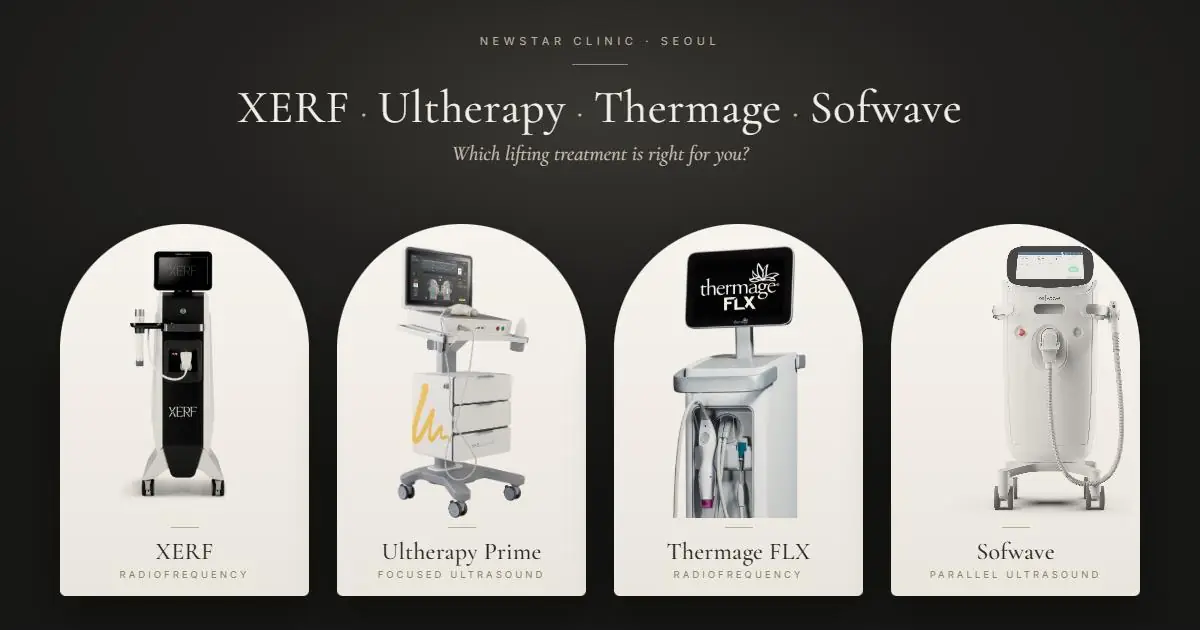
XERF and Thermage use radiofrequency to tighten the skin, while Ultherapy and Sofwave use ultrasound. Ultherapy reaches the deepest layer for sagging jawlines, and Sofwave suits fine lines with quick recovery. In Seoul, many patients combine a deep and a surface device in one visit.
Medically reviewed by Dr. Kang Kun Woo, Chief Doctor, Newstar Clinic · Last reviewed: October 26, 2026
"Ultherapy, Thermage, Sofwave, XERF... I just want my jawline back. Which one do I need?" It is one of the questions we hear most from international patients. These four devices use different energy and reach different depths, so the right one depends on your concern.
Lifting devices at a glance
XERF: radiofrequency (RF) at two frequencies · heats several layers at once · overall firmness and texture · FDA cleared in 2025
Ultherapy (Ultherapy Prime): focused ultrasound with live imaging · down to 4.5 mm (SMAS) · sagging jawline, cheeks and neck · FDA cleared
Thermage FLX: radiofrequency (RF) · broad heating of the dermis · skin tightening and lines around the eyes · FDA cleared
Sofwave: parallel ultrasound beams · mid-dermis at 1.5 mm · fine lines and mild laxity · FDA cleared
What is the difference between XERF, Ultherapy, Thermage and Sofwave?
The main differences are the type of energy and how deep it goes. Ultherapy and Sofwave use ultrasound, while Thermage and XERF use radiofrequency (RF). Ultherapy focuses ultrasound into points that reach the deepest layer, the SMAS. Sofwave heats the middle of the dermis. Thermage and XERF heat a wider area evenly to tighten the skin as a whole.
What is XERF?
XERF is an RF lifting device that Lutronic (now Cynosure Lutronic) first launched in Korea in 2024. It uses two frequencies, 6.78 MHz and 2 MHz, in a single shot to heat shallow and deeper layers together, with built-in cooling to protect the skin surface. It received US FDA clearance in August 2025, and US searches for it have grown fast since.
What is Ultherapy (Ultherapy Prime)?
Ultherapy uses micro-focused ultrasound to create small heat points at 1.5, 3.0 and 4.5 mm. The 4.5 mm depth is the SMAS, the same layer a surgical facelift tightens. Ultherapy Prime lets the doctor see the skin layers on live ultrasound imaging during treatment. In the US, it is FDA cleared for lifting the brow, under the chin and the neck, and for lines on the chest, with the abdomen and arms added in November 2025.
What is Thermage FLX?
Thermage uses radiofrequency to heat a broad area of the dermis, which helps collagen tighten and renew. It is also cleared for wrinkles around the eyes, including the upper and lower eyelids, so it is a common choice for loose skin around the eyes.
What is Sofwave?
Sofwave sends parallel ultrasound beams into the mid-dermis at about 1.5 mm, with real-time cooling to protect the surface. In the US, it is FDA cleared for facial lines and wrinkles, and in 2021 it was cleared for lifting the brow, under the chin and the neck .
Which lifting treatment is right for me?
Sagging jawline, jowls or double chin: Ultherapy
Thinner skin that has lost firmness and smoothness overall: XERF or Thermage
Lines and loose skin around the eyes: Thermage
Fine lines and mild laxity with quick recovery: Sofwave or XERF
Most faces have two or three of these concerns at once. Your doctor examines your face and chooses one device or a combination.
Is HIFU the same as Ultherapy?
HIFU (high-intensity focused ultrasound) is the name of the technology. Ultherapy is the best-known brand that uses it. Other HIFU devices exist, such as Shurink and Ultraformer, but Ultherapy Prime is different in that the doctor sees the skin layers on live imaging while treating.
Which one hurts the least?
Many people find Ultherapy the most uncomfortable because it reaches the deepest layer. RF devices feel hot, but cooling is built in. At Newstar Clinic, we apply numbing cream before treatment, and nitrous oxide (laughing gas) is available if you prefer.
Can you combine lifting treatments?
In Korea, it is common to combine a device that lifts the deep layer with one that tightens the skin. For example, Ultherapy for the deep layer, with RF or Sofwave for the skin. Even on a short trip to Seoul, your doctor can plan this in one visit. If volume loss is part of the problem, see our guide Ozempic Face: What Causes It and How Fillers Can Restore Lost Volume.
What about ONDA and Titanium, popular in Korea?
ONDA: uses microwave energy to heat the fat layer. It is widely used in Korea for the face and body, but it has only just started to arrive in the US. For body treatments, see Loose Skin After Ozempic, Wegovy or Mounjaro.
Titanium: a Korean lifting protocol that uses three laser wavelengths (755, 810 and 1064 nm) to heat several skin layers. It is not used on skin rich in melanin.
When will I see results, and how long do they last?
Some people feel tighter on the day, but most of the change builds over two to three months as new collagen forms. How long it lasts and when to repeat it depends on your age and skin, and your doctor will plan this at your consultation. For collagen-building injectables, see Juvelook vs Rejuran.
How much does lifting cost in Seoul?
The cost depends on the device, the number of shots and any combination in your plan. At Newstar Clinic, your doctor checks your face first, then we give you the final total including 10% VAT before treatment. Everyone pays from the same price list, whatever their nationality.
Not sure which lifting treatment fits you? Send us a photo of your face and your Seoul dates on WhatsApp.


